
How do I use ATMs abroad?
Product · 22 October 2025Clément Bolmont
Whether you're a seasoned backpacker or a first-time holidaymaker, worrying about getting cash out during your trip should be the last thing on your mind. Yet, for many travellers, using ATMs abroad can quickly become expensive — with unexpected fees slowly adding up.
We're here to change that. In this guide, we help you navigate international cash withdrawals, giving you the knowledge and tools you need to get the most out of your money with competitive rates and fees.
Types of international ATM withdrawal fees and rates
Fee 1: the hidden exchange rate trap
Dynamic Currency Conversion (DCC) is a service offered by the local ATM operator or merchant that gives you the option to pay or withdraw in your home currency (GBP) rather than the local one.
It seems helpful at first because you immediately see the final cost in pounds. However, when you choose to pay or withdraw in GBP, you give the local operator control over the exchange rate. This rate is almost always significantly marked up.
The rule of thumb: when the ATM screen asks you to choose between the local currency (e.g. USD or EUR) or your home currency (GBP), always choose the local currency. This ensures that the conversion is handled by your card provider (like us), which typically uses a much fairer rate.
Fee 2: foreign transaction fees from your UK bank
These fees, also known as non-sterling transaction fees or conversion charges, are applied by your UK bank simply because you're spending or withdrawing money in a non-GBP currency.
Traditional banks typically charge these fees in 2 ways, which can stack up quickly:
- Fixed fee: a flat rate, regardless of the amount (e.g. £1.50 or £5.00 per withdrawal)
- Percentage fee: a percentage of the transaction amount (usually 1–3% of the withdrawal value)
This is why looking for a travel money card with competitive fees is one of the most effective ways to save money when using ATMs abroad.
Fee 3: local ATM operator surcharges
This is a fee imposed by the owner of the ATM for the service of using their machine.
The good news is that these surcharges must legally be displayed on the screen before you confirm the transaction. You typically see a message like: "This ATM charges a €4.00 access fee. Do you wish to proceed?"
In some countries, these operator fees are rare, but in others (like the US, Mexico, or Thailand), they're common and often unavoidable at that specific machine. If the fee is too high, simply cancel the transaction and look for another ATM, preferably one attached to a national bank, which may waive or reduce the fee. Smaller, independently owned ATMs have a higher risk of surcharges.
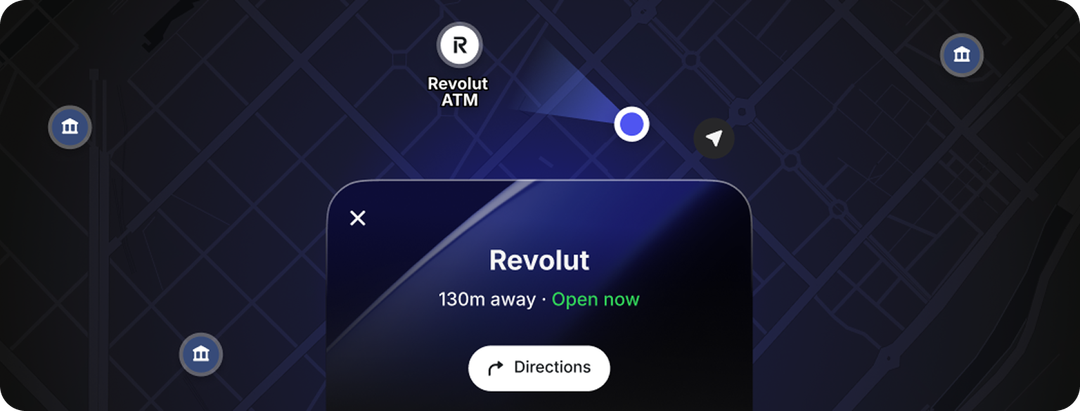
With Revolut, you can check in-app to find nearby ATMs from our network, so you don't have to suffer from that surcharge.
Understanding ATM networks and providers overseas
Your debit or travel money card works worldwide thanks to complex financial systems known as interbank networks. These networks connect your card issuer with millions of ATMs globally, allowing you to withdraw cash abroad almost anywhere you see their logo.
The role of Visa (PLUS) and Mastercard (Cirrus)
The majority of UK debit and credit cards operate on either the Visa or Mastercard network. These are the 2 largest networks globally and provide the widest coverage.
- Visa: uses the PLUS network for global ATM access. The PLUS network is widely represented in over 200 countries and territories, and is often the main local network you'll encounter in North America.
- Mastercard: operates the Cirrus and Maestro networks. Cirrus is found in over 90 countries and links all Mastercard-affiliated cards.
We provide our customers with either Visa or Mastercard physical debit cards, depending on availability. However, you can choose between them for your virtual card.
Specialised networks: Maestro, Interac, and UnionPay
You may see other big networks depending on where you travel. These include:
- Maestro: a multi-national debit card service operated by Mastercard, often found across Europe. Maestro cards are linked to the Cirrus network by default.
- Interac: this is the main domestic network used by Canadian banks. While Interac is primarily a local network, most Canadian ATMs are also connected to PLUS and Cirrus to accommodate international travellers.
- UnionPay: the only interbank network in mainland China, linking all bank ATMs in the country. If you're travelling to China, look out for the UnionPay logo.
Understanding the Global ATM Alliance
The Global ATM Alliance is a partnership between several large, traditional international banks (including Bank of America, Deutsche Bank, and Barclays). This partnership is designed to waive non-bank usage fees and ATM operator access fees for each other's customers when using an alliance member's ATM overseas.
Why this matters to you: while we're not part of this specific alliance, we offer a simpler solution. Our multi-currency card is designed to allow fee-free withdrawals up to your plan limit anywhere in the world that accepts Visa or Mastercard. This simplifies your travel, removing the need to search for a specific Global ATM Alliance member's machine. You benefit from low-cost withdrawals regardless of the bank. Third-party ATM fees may still apply on ATMs outside our 55,000 in-network ATMs.

What to expect from ATMs abroad
The cost and ease of withdrawing cash abroad can vary significantly by continent and country. Preparing for the specific fee landscape of your destination is a smart way to manage your finances.
Europe and the SEPA zone
For UK travellers, withdrawals within the Single Euro Payments Area (SEPA), which includes the Eurozone countries, are often the simplest.
- Low exchange rates: strong competition means exchange rates are generally fairer, especially when handled by a provider like us.
- The Euronet trap: be aware of independent ATM providers like Euronet, which exist mostly in tourist areas, especially in Spain, Greece, and Eastern Europe. They're notorious for pushing DCC and charging high operator surcharges.
Our advice: stick to ATMs attached to established national bank branches (e.g. BNP Paribas, Santander) and use a travel money card. If you’re using Revolut, look for surcharge-free ATMs in-app.
Asia and South America
In many popular destinations across Asia (like Thailand, Vietnam, and Indonesia) and South America (like Brazil, Mexico, and Peru), local ATM operator surcharges are common and can be high.
- High fees: it's normal to encounter fixed operator fees equivalent to £4–6 per transaction.
- Tactical solution: because the operator surcharge is a fixed cost, it makes much more sense to take out the maximum possible amount in one go, rather than multiple small withdrawals. This reduces the overall percentage cost.
Security tips: use ATMs inside bank lobbies during business hours where possible, and always be aware of your surroundings.
North America
The US and Canada are known for having high stacking fees, especially if you use an out-of-network machine, which is almost any ATM not run by your own bank.
- Stacking fees: you may be charged by your UK bank's currency exchange fee, the US bank's non-customer fee, and a non-network fee. Together, these fees can easily exceed £10 for a single withdrawal.
- Low limits: some US banks cap foreign card withdrawals at a low figure, such as $200–300, forcing you to withdraw cash multiple times and face those fees multiple times in order to get the cash you need.
Our advice: in North America, relying on card payments whenever possible and keeping cash withdrawals to an absolute minimum is the most cost-effective strategy.

Top 5 tips to reduce fees when using an ATM abroad
1. Always choose the local currency (Avoid DCC)
When the ATM asks if you want to proceed with the conversion and displays the amount in GBP, say no. Choose the option that says, "Continue without conversion" or "Withdraw in local currency”. This ensures your card provider's exchange rate is used, saving you from the hidden mark-ups of the local ATM operator.
2. Withdraw cash tactically (plan large, less frequent withdrawals)
While it’s never a good idea to travel with loads of cash, you can avoid frequent fixed ATM operator fees by mapping out a rough budget in advance and withdrawing cash in larger, less frequent amounts. If you're using an ATM that charges a fixed operator surcharge (e.g. £4 per use), making one £300 withdrawal is significantly cheaper than making 3 withdrawals of £100.
3. Use a card designed for travel money
Traditional UK banks often charge 2.75–3% for foreign transactions. However, specialist travel money cards like ours are built to solve this problem, using a clear exchange rate and offering fee-free withdrawal allowances based on your plan. This helps you save money overseas.
4. Avoid using a credit card for cash withdrawals
Using a credit card for cash withdrawals abroad is usually more expensive than using a debit card. Fees tend to be higher because withdrawals are treated as a cash advance, meaning:
- You're charged interest immediately, often at a high rate, with no interest-free grace period
- You may incur a separate cash advance fee (typically 3–5% of the amount)
Use your debit or prepaid travel money card for cash, and keep your credit card for emergencies or large, insured purchases.
5. Use your in-app ATM locator tool
Planning ahead saves time and money. Before you head to a new area, use an ATM locator tool, such as the one available in the Revolut app. This helps you:
- Find ATMs attached to major banks, which are generally safer and less likely to hit you with excessive surcharges
- Avoid the independent, high-fee machines found in convenience stores or tourist traps

Advanced security features for peace of mind
Security is a key priority when you're travelling abroad. With us, you can control your card's security features in-app:
- Freeze and unfreeze: instantly lock your card if you misplace it and unfreeze it when you find it
- Security controls: enable or disable features like contactless payments, magnetic stripe payments, or online transactions to suit your destination and usage habits
- Location-based security: optionally limit transactions to countries where your phone is located, adding an extra barrier against fraud
Start travelling with Revolut
If you want a fast, easy, and cost-effective way to handle money on your travels, we're ready to join you. Here's a step-by-step guide to starting your journey:
- Download the Revolut app: get it on the App Store or Google Play.
- Sign up: it only takes a few minutes. You'll need to verify your identity and confirm your address in the UK.
- Add money: link your existing bank account or use a debit card to put money in your Revolut account.
- Get your card: order your physical Revolut card in-app (card delivery fees apply). You can start using a virtual card immediately for online purchases or add it to Apple Pay or Google Pay.
- Travel with confidence: when you arrive at your destination, just use your Revolut card to pay or withdraw cash abroad at any ATM displaying the Visa or Mastercard logo.
Stop worrying about unfair exchange rates and bank surcharges, and focus on enjoying your holiday.
The information provided is accurate as of 14 October 2025.
+18. No withdrawal fees within plan limits. T&Cs apply. Third party may charge ATM fees.