
A new take on skills frameworks
People · 1 August 2025Team Revolut
Skills frameworks are a crucial tool in career progression — they offer a simple but effective way of showing your team what skills they need at each step of their career.
But traditional frameworks quickly become inconsistent and subjective as you scale, making them difficult for managers to use and employees to understand.
At Revolut, we've used our performance philosophy to create a scalable skills framework that delivers fairness and clarity. Find out more about our philosophy in our comprehensive performance management playbook, and learn how we create frameworks below.
Why traditional skills frameworks fail to scale
The problems with traditional frameworks fall into two categories:
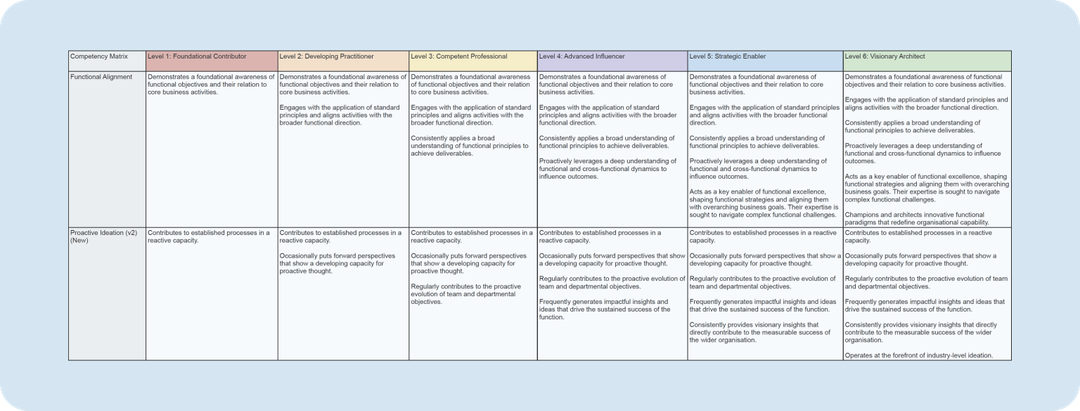
- Complexity — frameworks are built by managers, who define a junior employee's skills, then add requirements for mid-level, then more for senior. As you move up, the definition of 'good' becomes increasingly complex and unwieldy, because of all the additional requirements. It’s hard for managers to assess their direct reports and for employees to understand a clear path forward.
- Inconsistency — a product marketing manager and a finance manager might both need strong problem solving skills. But in a traditional framework, their managers define this skill independently of one another. This creates two completely different definitions for the same core competency, and makes it impossible to objectively identify top talent or spot company-wide skill gaps.
Building a skill-first framework
Our strategy is simple — define the skill first, then apply it to roles as needed. Here’s a short guide to putting our approach into practice:
Step 1 — Adopt the skill-first philosophy
Think about what universally-applicable skills your company needs to succeed — like data analysis, critical thinking, and problem solving — instead of focusing on the skill set of a particular role. This establishes a common language for frameworks across all departments, which is the foundation of our strategy.
It also discourages managers from independently creating frameworks for specific roles, which may be totally different from all other skills frameworks in the company.
Step 2 — Build your central Skills Library in Revolut People
Once you have a common language for skills, you can feed it into Revolut People to make it available to everyone. Access the Skills Library on our platform to define each skill and the specific, observable traits associated with it, across multiple levels of proficiency (Poor, Basic, Intermediate, Advanced, and Exceptional).
Step 3 — Create new roles and scorecards
With your Skills Library established, managers can create promotion criteria and assessment materials with ease. Simply access Revolut People, select pre-defined skills from the library, and set the proficiency level required for the role. The platform then instantly generates a standardised, objective scorecard for hiring or performance reviews, ensuring consistency across all departments.
Running objective and dynamic assessments
As well as offering a more consistent way to define roles, the skill-first approach turns performance reviews from simple conversations into data-driven assessments.
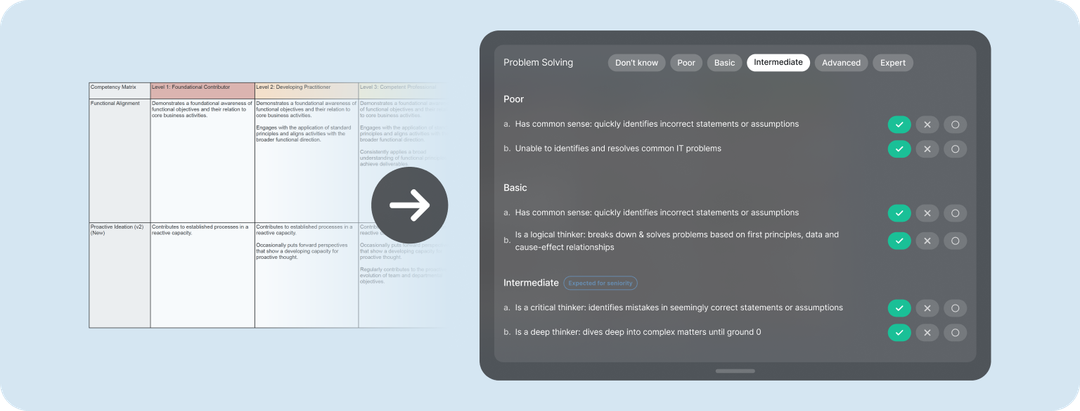
Instead of assessing employees based on subjective competencies, Revolut People provides managers with a series of yes-or-no questions to determine whether an employee demonstrates the listed observable traits for each skill.
A key part of our platform's design is that the observable behaviours are listed progressively. This means you'll only view the highest level of criteria for each skill as seniority increases — unlike traditional skills frameworks that display the junior and mid-level requirements even for senior employees.
So, once an employee meets the criteria for Basic proficiency, it’s assumed they'll already meet those criteria in future assessments. The assessment for Intermediate only presents the new behaviours required to reach the next level.
For managers, the benefit is only needing to answer a short list of clear yes-or-no statements. This keeps the entire assessment process streamlined and focused, no matter how senior the role.
To see this method in action, watch our on-demand session with Álvaro Peñacoba, Revolut's Head of Performance.
The outcome of skill-first reviews is a precise, objective snapshot of an employee’s capabilities, allowing for highly targeted feedback and tailored development plans.
The strategic benefits of a skill-first framework
- Fairness and objectivity — standardising the definition of every skill removes manager bias. Every employee is measured against the same criteria, creating a fair and transparent environment that helps retain your top talent
- Identification of top talent — our skills frameworks allow you to accurately identify your company's best problem solvers and strategic thinkers with ease. This level of visibility makes it easier to retain those employees, and assign them to your biggest challenges
- Improved scalability — with a well-established Skills Library, creating new roles is faster and onboarding new managers is simpler, because your definition of competency is already clearly defined
- Precise feedback — as both role criteria and individual assessments use the same skills language, it's much easier to identify exactly how an employee must improve to progress to the next level of seniority. Similarly, when managers are looking to fill a role, they can easily review the skills present in their team to find appropriate candidates
Get started with Revolut People
With our skills-first philosophy, you can replace inconsistent frameworks and overly-complex criteria. Instead, start building a scalable performance-first culture, using skill definitions that are clear and understood company-wide.
Revolut People provides the tools you need to implement our philosophy. Establish your central Skills Library, create consistent roles, and run objective, data-driven performance reviews that your team can trust.