
Private Markets, explained: what they are and how they’re opening up
Produkt · 27. Juli 2026Team Revolut
For decades, private markets have been a key part of how institutions and ultra wealthy individuals build wealth. Yet, access to private markets has historically been limited by high minimums and operational complexity.
Today, we're helping to change that: eligible investors can now access Private Markets funds on Revolut. In this guide, we explain what private markets are, how they work, and what that means for individual investors.
What are Private Markets?
Private markets represent investments in assets that aren’t traded on a public stock exchange — private equity (buying stakes directly in private companies), private credit (lending to private businesses), and infrastructure (investing in real assets like energy, transport, and data centres).
For decades, they've been a cornerstone of how the world's most sophisticated investors — pension funds, family offices, insurers, and university endowments — build long-term wealth and diversify beyond public markets. Many large institutions now hold a significant share of their portfolios in private markets.

Beyond the stock exchange
In the US, over 85% of companies with revenue over $100 million are privately held¹ — and in Europe that figure rises to over 90%. Increasingly, significant value is created before a company ever lists on a public exchange. As the graph below shows, over the last 25 years private equity has outperformed the S&P 500 by 3.8 percentage points a year. Private markets give investors a way to reach that activity — the growth being built beyond traditional stock exchanges — and to diversify beyond public equities.
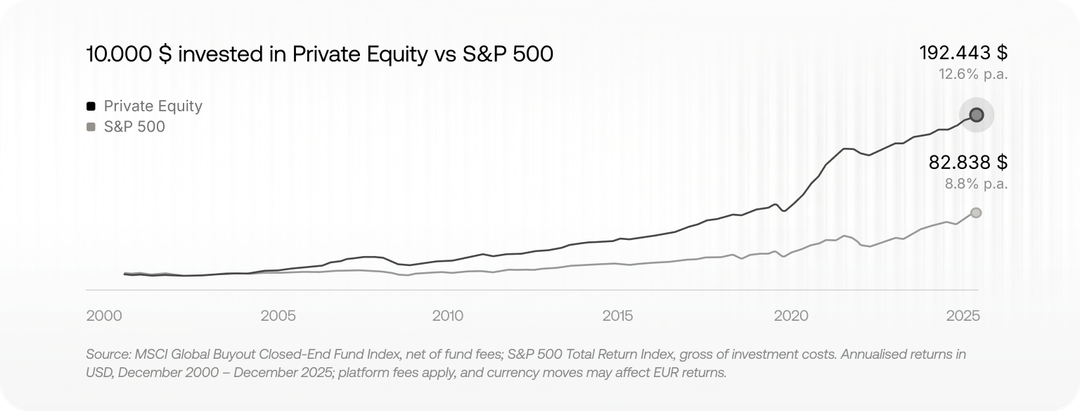
Note: Private indices track closed-ended, illiquid assets and should not be compared directly to liquid public benchmarks or the open-ended ELTIFs offered on Revolut. They are shown solely to illustrate historical asset-class trade-offs and are not direct product substitutes. Private Market funds offered by Revolut may invest in a single asset class or across private equity, private credit, and private infrastructure. Specific allocations for each fund are available in the app.
Why hasn’t this been available before?
If private markets are such a core part of institutional portfolios, why haven’t individual investors had access?
Historically, these funds required minimum investments of €100,000 or more, involved complex paperwork, and were often only available through private banks or institutional channels. For most people, the asset class was simply closed.
That’s now changing. In 2024, the EU introduced the ELTIF 2.0 framework—a regulation designed specifically to open private markets to individual investors, featuring built-in protections around suitability, disclosure, and liquidity. This framework is what makes the funds on our platform possible.
Why private markets take a longer view
Private markets work differently from public ones, and much of the difference comes down to time.
A private equity fund, for example, might buy a business, spend years improving how it operates, and only sell it once that work has paid off. Because value is built over time, these funds don't trade like stocks or ETFs — you can't buy and sell instantly. Redemptions happen at set intervals rather than on demand.
This is also why private markets are often associated with an “illiquidity premium” — the additional return investors expect in exchange for tying up their money for longer. It isn't guaranteed, though: past performance is no guarantee of future results, and you may get back less than you invest.
A curated range of funds
In public markets, buying an index fund gets you close to the market average. Private markets work differently: the gap between stronger and weaker-performing funds has historically been much wider, which makes fund selection especially important.
That's why, rather than opening the door to the entire market, we've selected a focused range of funds from globally recognised managers including Apollo, Ares, Hamilton Lane, and Partners Group. Drawing on insights from more than 15,000 funds, we've shaped the range available on our platform to focus on funds run by managers with scale and long track records.

How these funds work
These funds work differently from stocks and ETFs. Here's what to expect.
- Lock-up periods. Some funds restrict when you can sell after investing; others don't. Where a lock-up does apply, it may be a hard lock (you cannot redeem at all during the lock period) or a soft lock (you can redeem, but pay an early redemption fee if you do so before the period ends).
- Redemption windows. Once any lock-up has passed, you can typically request a redemption on a set schedule — often quarterly — rather than at any time.
- Redemption gates. In any given window, a fund may cap the total amount that can be redeemed across all its investors combined (commonly 5% of total fund value per quarter). This applies only when redemption requests are unusually high. Where the cap is reached, you may not be able to redeem your full request in that window — a measure that protects all investors by avoiding a forced sale of assets at an unfavourable time
- Valuations. Unlike stocks, which are priced continuously, these funds are typically valued at set intervals — often monthly. Between valuations the price doesn't move in real time, so the most recent valuation is the reference point.
- Fees. Private markets funds usually carry two charges: an annual management fee for running the fund, and a performance fee – a percentage of any returns above an agreed level. Exact costs vary by fund
Understanding the risks
Private market funds carry significant risks, including illiquidity, capital loss, and complexity, and have limited liquidity compared to publicly traded assets such as stocks or ETFs. These products may not be suitable for all retail investors. Revolut’s fund selection process does not eliminate investment risk. Past performance is not a reliable indicator of future results.
The value of investments can go up and down. Returns may be affected by currency fluctuations. Capital at risk. Before investing, please review the relevant Key Information Document (KID) and ensure this product matches your investment objectives, financial situation, and risk tolerance. T&Cs and fees apply. +18. For further information, please see Revolut’s Trading Terms and Conditions, Ex-ante costs and charges disclosure, and Risk Description.
Investment services in the European Economic Area are provided by Revolut Securities Europe UAB (company code: 305799582, registered address: Konstitucijos ave. 21B, Vilnius, the Republic of Lithuania, LT-08130), an investment firm authorised and regulated by the Bank of Lithuania. This information is not investment advice, recommendation or offer to take any investment decision and is supplied for informational purposes only. Revolut Securities Europe UAB acts as sub-distributor of the funds, which are made available through Allfunds Bank, S.A.U.
How we protect you
Private markets are not suitable for everyone. To be able to invest in private markets, you must first complete and pass a suitability assessment. Once invested, your account clearly shows lock-up status, fees, risk indicators, and redemption dates for every fund.
Specific fund availability varies by jurisdiction. Check the Revolut app to see which investment opportunities are available for you. Please ensure you're using the latest version of the Revolut app.
¹ Sources: Apollo/S&P Capital IQ; Hamilton Lane (2024–25)