Best places for currency exchange in Dallas: A complete travel guide
Financial basics · September 23, 2026Lydia Makin
Dallas blends big Texas energy with global business reach, and whether you're flying into DFW for a conference or heading out from North Dallas on your first trip abroad, getting your money sorted early is one of the easiest ways to make the journey smoother. The good news is that Dallas is one of the most card-friendly cities in the US. The catch is the fees: airport kiosks, mall-based exchange offices, and even your own card can quietly chip away at your travel budget.
This guide walks through everything you need to know about currency exchange in Dallas — from US dollar basics to the top physical exchange locations, the card-versus-cash question, and our app-based alternative that lets you hold and spend in multiple currencies without the usual hassle.
Revolut is not a bank, banking services are provided by Lead Bank, Member FDIC. Fees may apply. The Revolut USA Prepaid Visa and Prepaid Mastercard are issued by Lead Bank pursuant to licensing by Visa® U.S.A. Inc. and Mastercard International for Mastercard cards. Your funds are FDIC insured up to $250,000 through Lead Bank, Member FDIC. See revolut.com/en-us/ for more details.
18+, Terms and Conditions apply. Exchange fees, fair-usage limits, and weekend fees may apply.
Quick answer: What is the best currency exchange option in Dallas?
It's a good idea to use a bank ATM and pay by card wherever possible, rather than airport exchange kiosks.
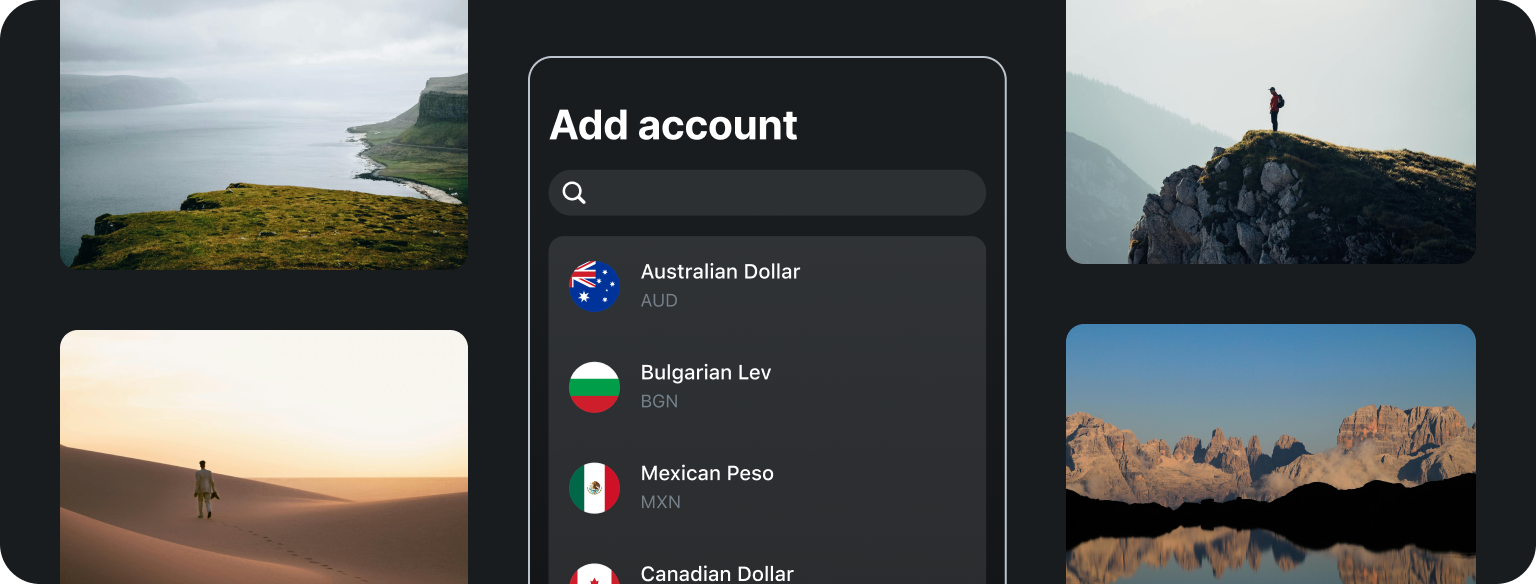
For a smooth experience, open a multicurrency account like ours before you travel, exchange your money to the currency you need in-app at the Revolut rate, and use a virtual or physical card to tap and pay. This lets you skip the airport counters and get competitive rates on your currency exchange.¹
Understanding US currency: US dollar (USD) basics
Before you change a single bill, it helps to know what you're actually spending. Dallas uses the US dollar, and the details matter — especially if you're an international visitor converting your home currency to USD, or a Dallas resident stocking up on foreign currency before a trip abroad.
What currency does the US use?
The official currency of the United States is the US dollar. The Federal Reserve Board is the issuing authority for US currency.
Some quick facts about USD:
- Currency name: US dollar
- Currency code: USD (short for United States dollar)
- Symbol: $
- Subunit: 1 dollar = 100 cents
- Banknotes in circulation: $1, $2, $5, $10, $20, $50, and $100
- Coins in circulation: 1¢ (penny), 5¢ (nickel), 10¢ (dime), 25¢ (quarter), 50¢ (half dollar), and $1
- Issued by: Federal Reserve Board
What does USD stand for?
USD stands for United States dollar, and it's the ISO 4217 currency code used by banks and financial systems worldwide. So when you see USD on a price tag or a currency converter, it simply refers to US dollars. For Dallas currency exchange, most kiosks quote rates against USD, whether you're buying euros, Mexican pesos, or British pounds.
Where to exchange currency in Dallas: Top physical locations
If you'd rather handle physical cash in person, Dallas has a handful of reliable options. The 2 most common are airport counters at DFW and mall-based kiosk across North Dallas and the surrounding suburbs. Below is a quick comparison to help you choose.
Exchange office | Where to find it | Notes |
ICE Currency Exchange in DFW Airport, Terminal D | 2333 S International Pkwy, DFW Airport, TX 75261 (gates D12, D22, and D24) | Open daily 6am–10pm, convenient on arrival and departure, handles 50+ currencies, but airport convenience can mean a less competitive rate than city bureaus |
Travelex at NorthPark Center | 8687 N Central Expy #2328, Dallas, TX 75225 | Mall location open during shopping hours, easy to combine with errands, rates tend to be more competitive than at the airport |
Texas Currency Exchange at The Shops at Willow Bend | 6121 W Park Blvd, Plano, TX 75093 | Open 7 days: Mon–Thu 11am–7pm, Fri–Sat 11am–8pm, Sun 12–6pm, suburban location with more competitive rates |
DFW Currency Exchange Services (CXI) at the Grand Prairie | 2615 W Pioneer Pkwy, Grand Prairie, TX 75051 | CXI agent location, open Mon–Sat 9am–6pm, offers a Best Rate Guarantee that matches or beats local bank rates on the same day |
DolEx Dollar Express on Jefferson Blvd | 300 E Jefferson Blvd, Dallas, TX 75203 | Specializes in remittances and Mexican peso exchanges, geared toward the local Hispanic community, strong MXN rates but limited currency selection |
Fee notes: Rates change daily, so it's a good idea to check the live rate on a currency converter before you visit. Bring a passport or government-issued ID, as most bureaus require it for exchanges over $1,000 or equivalent.
Currency exchange at DFW Airport
DFW Airport is a major international hub, and most currency exchange services are concentrated in Terminal D, which handles the bulk of international flights. ICE (International Currency Exchange) operates 3 counters there:
- Gate D24: International Departure, post-security, Level 2, near American Airlines Customer Assistance. Open daily 6am–10pm.
- Gate D12: International Departure, post-security, Level 2, against Whataburger. Open daily 6am–10pm.
- Gate D22: International Arrival, pre-security, Level 1, after Customer Exit. Open daily 6am–9pm.
Travelex also runs counters at DFW, with locations reported near gates D11, D22, D24, and D36, plus a booth in Terminal E.
Terminals A, B, C, and E have ATMs but no dedicated currency exchange counters. Airport counters are convenient, but their rates tend to be less competitive than downtown options, so it's a good idea to exchange only a small amount — say $50–100 — for what you need to pay for right now, like a taxi or a tip, and get the rest in the city or from an ATM.
Best currency exchange in Dallas, TX: Downtown options
Most of Dallas's dedicated exchange offices sit in North Dallas and suburban malls rather than downtown, so plan accordingly. Travelex at NorthPark Center is one of the most accessible, open during mall hours on Level 2. Texas Currency Exchange at The Shops at Willow Bend in Plano offers more competitive rates and is open 7 days a week.
For a rate guarantee, CXI's DFW Currency Exchange Services in Grand Prairie publishes a Best Rate Guarantee that matches or beats any local bank for the same currency and amount on the same day.
Casa de cambio and Mexican peso exchange in Dallas
Dallas has a large Hispanic and Latino population, and many residents exchange USD and Mexican pesos regularly. For USD/MXN exchange, casa de cambio options like DolEx Dollar Express often offer more competitive peso rates than generic bureaus. DolEx has multiple Dallas locations, including 300 E Jefferson Blvd and 5306 W Davis St, and specializes in remittances and peso exchange.
These stores focus on a handful of currencies — mainly MXN, CAD, and a few others — so for less common currencies, a full-service exchange office or a multicurrency account might be a better fit.
Can you exchange currency at a bank in Dallas?
Major banks like Chase, Bank of America, and Wells Fargo offer currency exchange, but they typically offer less competitive rates than specialized exchange offices, and may not stock less common currencies. Some branches require you to be an account holder, and you may need to order foreign currency in advance and wait a few days for delivery.
Banks are convenient if you're already a customer, but expect rates that are less competitive than a specialized bureau or a multicurrency account.
Cash vs card in Dallas: What should you use?
Dallas leans heavily toward card payments, and contactless is accepted almost everywhere — restaurants, shops, ride-share, and even many small vendors. That said, carrying a small amount of cash is still smart for tips, taxis, parking meters, and the occasional spot that prefers bills. The real question isn't cash vs card, it's how to use each while keeping fees to a minimum.
Actionable ATM tips for Dallas
- Use bank ATMs, not private ones: Stick to machines inside or attached to banks. Avoid standalone ATMs in tourist areas, which often carry less competitive rates and extra fees.
- Always choose USD, never your home currency: If an ATM or card terminal offers to charge you in your home currency, decline. That's dynamic currency conversion, and it uses a rate that's typically much less competitive than your card provider's.
- Use a debit card for withdrawals: Credit card cash withdrawals come with high fees from both your issuer and the ATM operator.
- Check your card's foreign transaction fee: Many cards charge 1–3% per foreign transaction. Opting for a travel-friendly card can help you save.
Using US debit and credit cards abroad
For Dallas residents heading overseas, US-issued Visa and Mastercard cards are widely accepted across most destinations. The main thing to watch is your card's foreign transaction fee — many US cards charge a 2–3% foreign transaction fee on every purchase made abroad, on top of an exchange rate that's rarely in your favor. A Revolut card handles foreign spending at competitive rates.
ATM withdrawals and dynamic currency conversion (DCC)
The single biggest fee trap for travelers is dynamic currency conversion (DCC). When you insert your card into an ATM or present it at a card terminal while you're abroad, the machine may ask whether you'd like to complete the transaction in the local currency or your own. The option to pay in your own currency seems helpful, since you'll be able to see how much is going to leave your account, but it uses a rate that's typically much less competitive than your card provider's. Always opt to pay in the local currency to get your provider's rate.
Delivery fees may apply.
Pay and convert money with Revolut
With a Revolut multicurrency account, you can hold and exchange US dollars in-app at the Revolut rate, then spend at the checkout with a virtual or physical card.¹
We exchange currency at the competitive Revolut exchange rate, and there are no additional currency exchange fees on weekdays during foreign exchange market hours, as long as you stay within your plan's fair usage limit. You can create a virtual card right away in-app for secure spending both online and in-person via Apple Pay or Google Pay.
You can also use your physical card to withdraw cash from ATMs at competitive exchange rates with no fees from us during market hours and within your plan limits,² so you always have the right cash for tips and local spots that don't take cards.
How to open a Revolut account for Dallas currency exchange
If you'd like to skip the exchange offices and manage your currencies from your phone, here's how to get set up with Revolut before your trip. The whole process takes a few minutes, and you don't even need to leave the house.
- Download the Revolut app and sign up for an account. You'll need to be 18 or older and verify your identity with a government-issued ID and your SSN or a supported visa.
- Add money to your account via bank transfer, debit card, or another supported method.
- Open a currency space in-app and exchange your money at the Revolut rate. You'll see the rate and any applicable fees before you confirm.
- Order a physical card for in-store spending (delivery fees may apply), or get a virtual one to start spending right away, anywhere Visa or Mastercard is accepted.
- You'll get a notification whenever you make a payment, so you can track your spending in real-time.
For more on getting started, see our guide to getting a Revolut card in the US.
¹Exchange and global transfer fees, fair usage limits, and Terms and Conditions apply.
²No ATM withdrawal fees within plan limits on a monthly basis. Out-of-network ATM withdrawals are subject to a 2% fee for Standard customers, and a 2% fee for Premium and Metal customers once their plan limits are exceeded. Third-party providers may charge a withdrawal fee. Currency and ATM fair-usage fees apply. Weekend markups on currency exchange will apply. Foreign exchange market hours begin at 6pm ET on Sunday and end at 5pm ET on Friday.
The information provided is accurate as of September 9, 2026. The content of this page is for general information purposes only and does not constitute financial advice. If you have any questions about your personal circumstances, please seek professional and independent advice. Revolut is not a financial advisor.